What Is Concrete? Meaning, Composition, and Its Role in Indian Construction
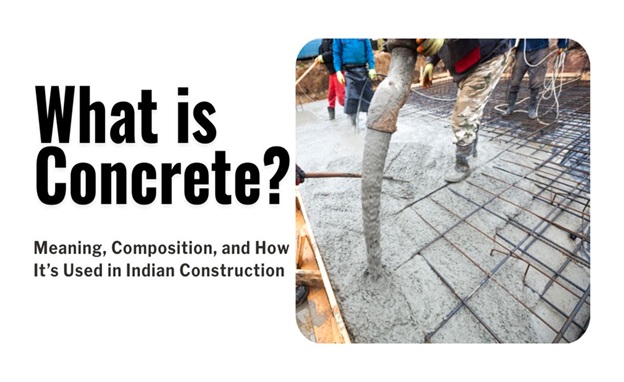

If you’ve ever been near a construction site in India, you’ve seen concrete being mixed and poured. From a small two-bedroom home to big bridges and malls, concrete is everywhere. But what is concrete, exactly? Most of us know it as “cement ka mix”, but it’s a bit more than that.
What Is Concrete?
Concrete is a strong mixture that holds your house together. Floors, pillars, beams, roofs – all of these are made from concrete. Once it sets and hardens, it’s like stone.
The proper concrete definition is simple: It’s a mix of cement, sand, stone chips, and water. Mix them in the right way, and you get concrete. In every small house, big bungalow, or city flat, concrete is the backbone.
Concrete in Indian Construction
In Indian construction, when someone says “concrete”, they’re usually referring to the strong mixture used for building slabs (chhat), columns (pillars), and beams. Whether it’s a small house or a big apartment, concrete forms the main skeleton of any building.
What Ingredients Go Into Concrete?
Concrete may feel like a fancy term, but its ingredients are simple and easily available in every Indian town.
This is the glue that binds the mix. Brands like JK Cement, UltraTech, and Ambuja are common in India.
- Sand:
Usually river sand or M-sand. Sand gives body to the mix.
- Stone Chips
Small stones, usually 10mm or 20mm in size, give strength to concrete. These are locally sourced from crushers.
- Water:
Water activates the cement and holds the mix together. Always use clean water.
What Is the Mixing Ratio in Concrete Composition?
For concrete to be strong, the correct concrete composition matters. Typical mix used on Indian sites:
1:2:4 mix – 1 part cement, 2 parts sand, and 4 parts stone chips. This is common for floors and simple work. For stronger needs like pillars or slabs:
1:1.5:3 mix – Slightly more cement and less stone to make it denser. Water is added slowly to make a paste that’s neither too watery nor too dry.
On bigger projects in cities, ready-mix concrete (RMC) is ordered from plants, where it’s mixed in machines. But in most Indian homes, concrete is still mixed by labourers on-site, using simple tools.
How Concrete Is Used in Indian Homes
- Concrete is used almost everywhere:
- Foundation: To lay the base of your home.
- Columns and Beams: To hold your roof and structure.
- Slabs (Chhat): Your roof is mostly a thick concrete slab.
- Floors: Ground floors in many homes are made of concrete, covered later with tiles or marble.
- Boundary Walls: Many walls use concrete poured into moulds.
Why Concrete Is Trusted in Indian Construction
Simple reason: it’s strong, easy to make, and lasts for years.
- Materials are cheap and easily available.
- Once poured, concrete sets quickly.
- Less maintenance needed.
- Can handle heavy rains and hot weather.
Things You Should Know As a Homeowner
If you’re building your home and want the concrete to be strong:
- Use good-quality cement.
- Make sure your sand is clean, not mixed with too much clay or dirt.
- Check that stone chips are of uniform size and free from dust.
- Ensure workers don’t add too much water (watery concrete gets weak).
- After pouring, the concrete should be cured (kept wet) for at least 7 days.
These steps help avoid cracks and weak structures.
What’s New in Concrete?
While basic concrete is still used widely, cities are moving towards:
- Ready-Mix Concrete (RMC): Prepared in factories and delivered in big mixers.
- Fibre-Reinforced Concrete: Added fibres like steel or glass to control cracks.
- Eco-Friendly Concrete: Using fly ash or waste products to reduce cement usage. But for small homes, traditional site-mixed concrete still works best.
So, what is concrete? It’s the basic building block of every Indian home. From tiny village houses to modern bungalows, concrete holds everything together. Concrete is:
- Simple to mix.
- Strong and lasting.
- Affordable for all budgets.
When building your dream home, knowing the concrete meaning, ingredients, and correct mix can help you supervise your work better. After all, your house’s strength depends on how well the concrete is mixed and poured.
Your contractor would know the work, but as a homeowner, a little knowledge about what concrete is always helps.
At the end of the day, concrete is nothing fancy. It’s just cement, sand, stones, and water – mixed with care and poured with trust.
FAQs
1. Is concrete the same as cement?
No. Cement is just one part of concrete. Cement is like the glue that holds things together. Concrete is the full mix — cement, sand, stone chips, and water. Cement alone can’t build your roof or pillars.
2. What type of sand should I use in concrete?
Use clean river sand or M-sand. Make sure it’s not mixed with too much soil or mud. Dirty sand weakens concrete. In many towns, M-sand is now common as river sand is expensive.
3. Can I mix concrete myself, or should I buy ready-mix?
For small home work, you can mix concrete on-site. Labourers mix it manually using the correct ratio. But for bigger slabs or heavy work, ordering ready-mix concrete (RMC) saves time and ensures proper quality.
4. How much water should go into concrete?
This is important. Only enough water to make the mix workable — not too watery. If concrete looks too wet, it’ll become weak once dry. A thick paste-like mix is ideal. Keep an eye on workers – they often add excess water for easy mixing.
5. How long does concrete take to become strong?
Concrete starts setting in a few hours but needs at least 7 days of curing (keeping it wet). Full strength usually comes after 28 days. So after pouring, water the concrete daily for a week for best results.
6. Where exactly do we use concrete in a house?
Concrete is everywhere — in your house foundation, columns, beams, roof slab (chhat), and even your floor base. Walls may use bricks, but concrete is the skeleton of your home.
7. How can I check if the concrete is mixed properly?
Simple things to watch:
- The mix should not look watery.
- Cement should coat the stones evenly.
- When poured, it should settle without too much segregation (stones separating from the mix).
- Once hardened, the surface should feel strong, not crumbly.