Trenchless Engineering: The Engineering Principles of Horizontal Directional Drilling
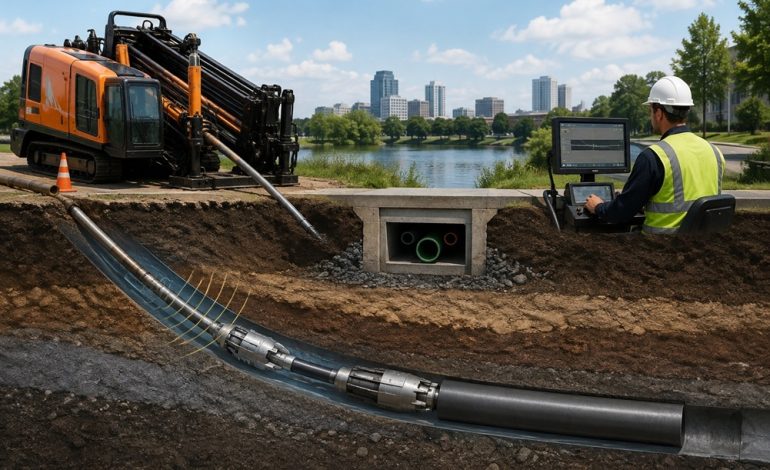

Installing subterranean utility infrastructure in modern urban environments and across natural landscapes presents significant civil engineering challenges. Traditional open-cut excavation—which requires digging continuous surface trenches—causes major surface disruption, damages established roads and landscapes, creates severe traffic congestion, and requires extensive environmental reinstatement.
To overcome these limitations, the utility and civil engineering sectors increasingly utilize trenchless technology. Among these trenchless methodologies, Horizontal Directional Drilling (HDD) stands out as a highly versatile solution for installing underground pipelines, cable ducts, and utility lines beneath surface obstacles with minimal disturbance.
The Three Operational Phases of Directional Drilling
Horizontal Directional Drilling is a surface-launched, steerable trenchless technique designed to place subterranean infrastructure along a predetermined curved path. The execution of an HDD bore follows three core engineering stages:
1. Drilling the Pilot Bore
The process begins by positioning a directional drill rig at a designated entry pit on the surface. A specialized drill bit, attached to flexible high-strength steel drill pipe, is pushed into the ground at a shallow entry angle. As the drill string advances, the steerable drill head carves out a pilot pathway through soil or rock formations.
Steering control is achieved using an asymmetric slanted drill bit or fluid-jet deflection techniques. As the non-symmetrical head is rotated, it drills straight ahead; when held at a fixed angle and pushed forward, it steers the path in the desired direction. High-precision guidance systems—such as walkover electromagnetic sondes or deep-level wireline guidance systems—continuously monitor the drill bit’s exact position, depth, pitch, and compass alignment. Wireline steering is particularly vital when executing deep bores, crossing under wide rivers, or steering close to existing subterranean services where sub-millimeter tracking accuracy is required.
2. Hole Enlargement (Back-Reaming)
Once the pilot drill head completes its planned trajectory and emerges at the designated exit pit, the drill bit is removed. In its place, a specialized cutting tool called a back-reamer is attached to the drill string.
The drill rig then rotates and pulls the reamer back toward the entry rig, expanding the pilot hole to a larger diameter. Depending on the final utility pipe size, multiple reaming passes using progressively larger reamers may be conducted until the bore hole diameter reaches approximately 12 inches (300mm) wider than the outer diameter of the product pipe.
Throughout the reaming phase, high-pressure drilling fluid—typically a fluid mixture consisting of roughly 95% water and 5% bentonite clay (a natural, non-toxic mineral)—is continuously pumped down the drill string. This bentonite fluid serves several critical functions:
- It cools and lubricates the cutting tools.
- It stabilizes the unlined bore walls, preventing soil collapse.
- It suspends excavated soil cuttings and flushes them out of the borehole to surface recycling systems equipped with desanders and shale shakers.
3. Product Pipeline Pullback
After the borehole has been enlarged and conditioned, the final utility product pipe—typically constructed from High-Density Polyethylene (HDPE) or welded steel protected by corrosion and anti-abrasion coatings—is laid out behind the exit pit.
The pipe string is attached to the back-reamer via a swivel connection, which prevents the rotary motion of the drill string from twisting the pipe string during installation. The drill rig then pulls the entire pipeline back through the fluid-filled bore until it reaches the entry pit on the surface, completing the subterranean installation.
Overcoming Challenging Ground Formations: Advanced Rock Drilling

While standard bentonite fluid jets and rotary bits operate effectively in clays, silts, and sands, encountering hard rock formations such as granite, sandstone, or dense cobble requires specialized drilling setups. Advanced rock drilling employs several engineering techniques:
- Dual-Pipe All-Terrain Rigs: These systems use an inner rod to drive a high-torque mechanical rock bit at high RPMs, while an outer pipe handles steering orientation and fluid circulation.
- Hydraulic Mud Motors: Downhole hydraulic motors driven by high-pressure drilling fluid turn a tungsten-carbide roller cone or PDC (Polycrystalline Diamond Compact) bit directly at the face, eliminating the need to rotate the entire drill string through abrasive rock.
- Pneumatic Air Hammers: For extremely hard, solid rock formations, compressed air hammers strike the rock face thousands of times per minute to fracture hard strata, allowing the drill string to advance efficiently.
Key Benefits of Horizontal Directional Drilling
Horizontal Directional Drilling offers significant advantages over conventional open-cut trenching methods:
- Environmental Preservation: By passing far below surface features, HDD preserves topsoil, mature trees, natural waterways, and sensitive wildlife habitats.
- Minimal Surface Disruption: Because operations take place deep underground between entry and exit pits, HDD eliminates major road closures, detour routes, and business interruptions in busy commercial areas.
- Reduced Installation Costs: Trenchless installations eliminate the high cost of heavy excavation, aggregate import, soil removal, and expensive asphalt or concrete road reinstatement.
Enhanced Site Safety: Avoiding long, open trenches removes deep excavation hazards, improves worker safety, and reduces the risk of accidental utility strikes.